Out of the many exercise science related occupations available, physical therapy is one of the most promising due to various reasons ranging from pay to career advancement options.
Physical therapy has become a popular career choice for many students that have a degree in exercise science or interested in movement science. In absolute terms, whether PT is is the “best” career related to this field is completely subjective.
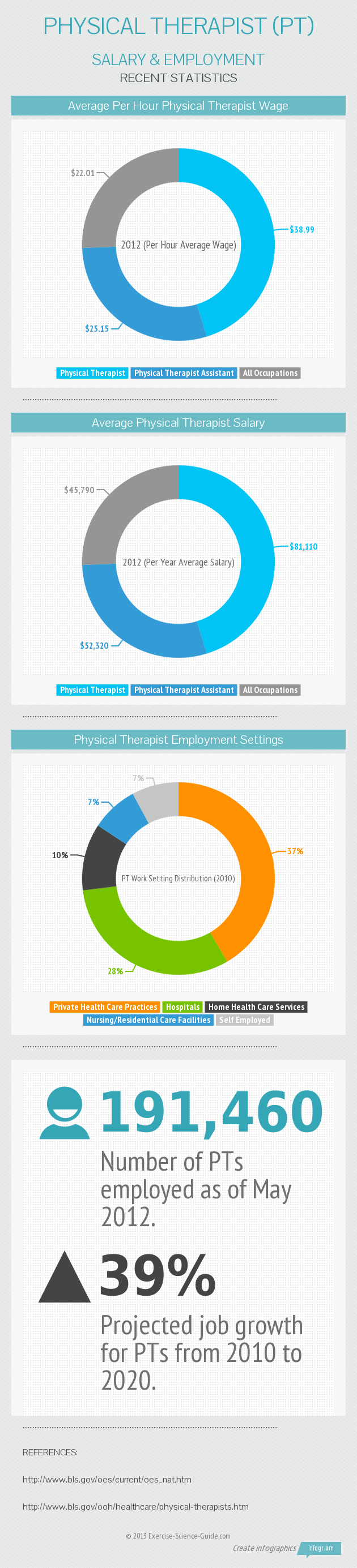
However, in terms of job security it’s hard to argue against it not being at the top. A whopping 39 percent growth in employment has been slated for physical therapists over the decade between 2010 and 2020, with PTs earning a salary approximately 56% higher than the national average for all occupations.
Aside from pay, job security and being able to work in a field heavily rooted in exercise science, this health career option is an excellent choice for those looking for an intrinsic benefit from the positive impact they make in the lives of people they work with.
The ultimate objective of physical therapy is to bring back motor functionality as close to a normative state as attainable for patients to carry out activities of daily living without discomfort and limitations. In the case of patients with permanent disabilities, the goal is to help them function more efficiently.
Physical Therapist: Definition and (Very Brief) History
The APTA (American Physical Therapy Association) describes a physical therapist as a…
“Health care professional; who maintains, restores, and improves movement, activity, and health, enabling individuals of all ages to have optimal functioning and quality of life while ensuring patient safety and applying evidence to provide efficient and effective care.”
Spanning the better part of a century, the progression of this rehabilitation profession (which began in the early 1900’s largely in response to the 1916 polio outbreak) has seen academic/training criteria reformed significantly from early reconstruction aide training programs to the current standards of a DPT (Doctor of Physical Therapy) degree and state licensure.
Key Personal Traits Needed of a PT
There are a number of necessary attributes to both successfully work as and enjoy being a physical therapist. One of the key personality traits would be compassion. PTs tend to have as part of their career ambition an eagerness to help people. The majority of PTs sincerely care about their patients making the best recovery possible.
It is also crucial to be meticulous with details. For example, a seemingly small piece of information in a patient’s health record could determine the course of rehabilitation; therefore, PTs have to be cognizant of any pre-existing health risk factors or conditions throughout the patient assessment and treatment phases.
Coordination is another essential attribute because of the sometimes delicate tasks that are needed to physically assist and treat patients.
Additionally, professional communication abilities are integral due to the fact that one must form a good rapport with patients to be able to obtain information and feedback, as well as effectively communicating with other health care professionals.
Last but not least, muscular strength and endurance is important for physically assisting and supporting patients during various modalities.
General Walk-Through of What a PT Does
When physical therapists see a new client, they set in motion the rehabilitation process by reviewing patient records and results of recent medical examinations, as well as collecting new information on the patient’s health & lifestyle behavior, occupation, and primary areas of discomfort.
Then, the PT performs a thorough qualitative and quantitative assessment of the patient that measures musculoskeletal and neurological components to gauge current functionality. After this, the therapist will ascertain to which degree any may impact the person’s capacity to complete life tasks on a day-to-day basis. PTs may also use highly specified manual diagnostic tests, such as anterior and posterior drawer for shoulder or knee, to determine the degree of impairment the patient has and the best course of treatment.
Common treatments solutions typically consist of various therapeutic exercise modalities, home exercises, custom brace/support apparatus fabrication, and applied therapeutic modalities such as electrical muscle stimulation, hydrotherapy and ultrasound.
Apart from rehabilitating patients, some physical therapists have the potential to assume other job functions in other areas including facility/department management, clinical research, and academia.
The Road to a PT Career: From School To Post-Graduate Education
All physical therapy schools require that applicants hold a bachelor’s degree; doesn’t necessarily have to be in a science subject - any major is acceptable as long as pre-PT prerequisite courses are completed. Over the past decade, the two degrees most commonly granted to become a PT have been the Master of Physical Therapy (MPT) and Doctor of Physical Therapy (DPT). Currently, the DPT degree is considered the “gold standard” educational credential for this profession.
Education must be obtained from a CAPTE (Commission on Accreditation in Physical Therapy Education) accredited physical therapy program in order to be eligible to earn necessary licensure/certification from the state of practice. Graduate education for this profession involves a mostly core medical and applied movement science curricula.
On top of coursework or didactic training, PT students are required to do multiple medical facility rotations to gain clinical experience with various areas of patient rehabilitation. Training beyond this is optional and is offered in the form of residency programs that take an additional 12 months or more depending on specialty, which include sports medicine, cardiopulmonary and pediatrics. Fellowships are also available (typically following a residency) to bring specialized expertise to the highest level.
Each of the 50 states require PTs have a license to practice, requiring graduates to pass the NPTE (National Physical Therapy Examination) and possible fulfill other criteria depending on the specific state. To maintain licensure, most states require its physical therapists to meet continuing education (CE) requirements every 1 or 2 years to ensure they keep up-to-date on current standards of care in the profession. The CE requirements can vary widely by state with some states presenting no criteria at all.
PT Employment Outlook and Pay
The median salary of physical therapists as of May 2012 was $79,860 or a $38.39 per hour median wage. From 2010 to 2020 job opportunities in this profession have been projected to climb by approximately 40 percent. Much of the demand is the result of aging baby boom generation (people born between 1946 and 1964) that are staying physically active much longer than past generations.
The following infographic further outlines key salary and employment statistics for this growing therapy occupation:
Infographic: Physical Therapy Salary and Employment in 2013