
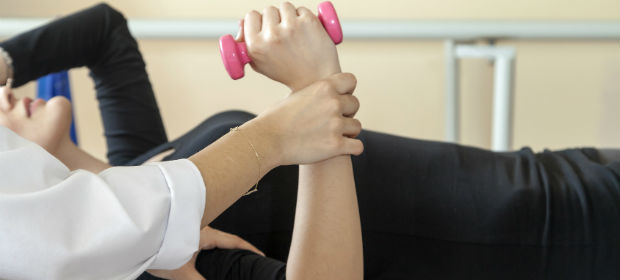
As two integral fields of movement rehabilitation, Physical and Occupational Therapy are completely separate professions, though share some similarities.
Under the umbrella of rehabilitation science are two major divisions of therapy: physical and occupational. Both areas share similarities yet are separate, unique health care occupations.
PT’s (Physical Therapists) and OT’s (Occupational Therapists) function to preserve and strengthen patients’ physiological and psychological condition, and it’s not unusual for them to work in the same area or even together on the same patient.
The main difference is, whereas Physical Therapists work to achieve the optimum range of motion and mobility in a patient after an injury to the musculo-skeletal system or due to a disease-related physical impairment, Occupational Therapists typically treat those with various restrictions and incapacities to perform their activities of daily living on their own, including taking care of themselves and restoring functionality in their workplace.
In other words, PTs work to bring back motion (i.e., rehabilitating patients to get up and walk on their own) and OT’s help to renew functionality (i.e., enabling or to participate in their work or daily activities).
Types of Physical and Occupational Degrees
A graduate level education is required to be either an OT or a PT - each having its own specific degree designation.
DPT (Doctor of Physical Therapy)
Physical therapists will now need a Doctor of Physical Therapy (DPT) degree, which takes approximately 3 years to complete, from an accredited program as well as successfully pass the NPTE (a national licensing examination. Previously, an MPT or Master of Physical Therapy degree was considered the entry-level credential for becoming a PT, however the DPT is now set as the necessary degree for new PTs to practice in this profession as of 2015.
Current physical therapists will eventually need to obtain their DPT via a transitional PT program (tDPT) in order to achieve the extent of education and instruction required for practice down the road.
MOT (Master of Occupational Therapy)
Earning an MOT or Master of Occupational Therapy degree from an accredited program (generally a 2-year long curriculum) in addition to successfully completing the NBCOT - the national OT licensing examination - is necessitated for occupational therapists to practice. While a doctoral education is not necessary in becoming an OT, those considering getting involved with research, regulation or academic roles in the field should look into the OTD or Doctor of Occupational Therapy degree, which is a 3-year course of study and training.
Before Pursuing PT or OT
Make certain of your passion for the profession and experience what’s required to be a PT or OT by means of observation and volunteering. Speak with or follow a Physical or Occupational Therapist. Search for therapists through your connection with your school, family or friends, by volunteering in a medical center or rehabilitation clinic, getting in touch with PT/OT programs, or a pre-health career student association. Numerous schools underscore the significance of a range of clinical experiences, such as those obtainable at major medical facilities, outpatient clinics, private practices with some programs requiring at least 100+ hours of PT/OT of work/volunteer experience in a clinical setting.
Taking part in extracurriculars makes it possible for you to establish abilities that will carry over to your potential occupation such as effective intercommunication, resourcefulness, empathy and responsibility to name a few. These activities outside of school are also an excellent means to become acquainted with individuals that can be a potential source of a letter of recommendation. Don’t forget to take note of when, where and the time period you were involved with each extracurricular.
Academic Preparation
There isn’t a mandatory or favored undergraduate major for acceptance into a PT or OT graduate program. You should go into a bachelor’s curriculum you believe you’ll do best in and personally have fun in. Physical and Occupational Therapy schools in most cases need to see a minimal grade point average of 3.0, however the GPA of those accepted may be considerably greater in more competitive programs. It really is of the utmost importance to do your best in undergrad. If you have a lower GPA, you can overcome poor grades by showing an increasing trend in your GPA. This will really help as it looks like you’re motivated to improve and have the ability to achieve good grades.
Most importantly, you will be required to complete a number of pre-requisite courses to apply. You’ll want to make sure to do your absolute best in these courses. A combination of biological, physical and psychological sciences, these required classes differ broadly from program to program, so get in touch with every school you plan on applying to for their specific criteria.
The most typical group of pre-req’s consist of:
- General Biology 1 w/ laboratory
- Anatomy & Physiology w/ laboratory
- General Chemistry 1 and 2 w/ laboratory
- Physics 1 w/ laboratory
- Psychology and Sociology
- Statistics
- English Composition or Writing
Sometimes required:
- Exercise Physiology
- Upper-level Biology courses
- Organic Chemistry 1 w/ laboratory
- Biochemistry
- Pre-calculus or Calculus
If you’re currently an undergrad, your academic institution may not offer some of these courses. In this case, it’s recommended to take the course(s) at a surrounding community college as it tends to cost less and the grad school admissions staff should not differentiate in whether a prerequisite course was taken at an Ivy League school or community college. What matters is the grade you get.
The Application Process
Physical and Occupational Therapy schools usually start accepting applications in the summer and early fall months of the year prior to enrollment. Programs that begin taking applications in other months may have different enrollment timelines. Make sure to confirm with the schools you plan on applying to about these details and send in your completed application way in advance of the cutoff date. The sooner you submit your application the better.
If you feel you are currently not sure about applying, you may want to hold off until you acquire more volunteer experience in the field, improve your grade point average or find people that can write you a solid letter of recommendation.
How Many Schools Should You Apply To?
It’s common for students to send application to between 5 to 8 schools. You should go for schools taking into account your strength as an applicant, the specific course of study and learning facilities, the schools’ notoriety among the rehabilitation sciences community, location, tuition, license examination pass rates, and work placement opportunities. You can look through listings of programs at the APTA (Physical Therapy) and AOTA (Occupational Therapy) websites.
Ways To Apply
Most PT and OT programs allow you to apply through PTCAS (Physical Therapist Centralized Application Service) or OTCAS (Occupational Therapist Centralized Application Service). These organizations collate your transcripts, personal statement, LOR’s (letters of recommendation), documentation of work/volunteer/observation hours and GRE results into your own personal file to make everything easier and more convenient for both sides.
Some programs request and additional application along with the centralized one. Carefully go over any supplemental materials that may be required from the programs to which you’re applying. Regarding schools that don’t take part in PTCAS and OTCAS, you should be able to download an application or apply online via their official website. Make sure to prepare as much as you can in advance as certain steps involve more time than others.